Triple Net Lease (NNN)
Triple net lease investments, commonly called NNN properties, are among the most popular passive income vehicles in commercial real estate. They attract everyone from first-time commercial buyers to seasoned investors completing 1031 exchanges, and for good reason. When structured correctly, they offer something rare in real estate: long-term, predictable income with very little required of the owner.
But not all NNN deals are created equal. The tenant matters. The lease terms matter. The location, the cap rate, the years remaining, and how the property fits into your broader tax strategy all matter. What follows covers everything you need to evaluate an NNN investment with confidence.
What is a Triple Net Lease?
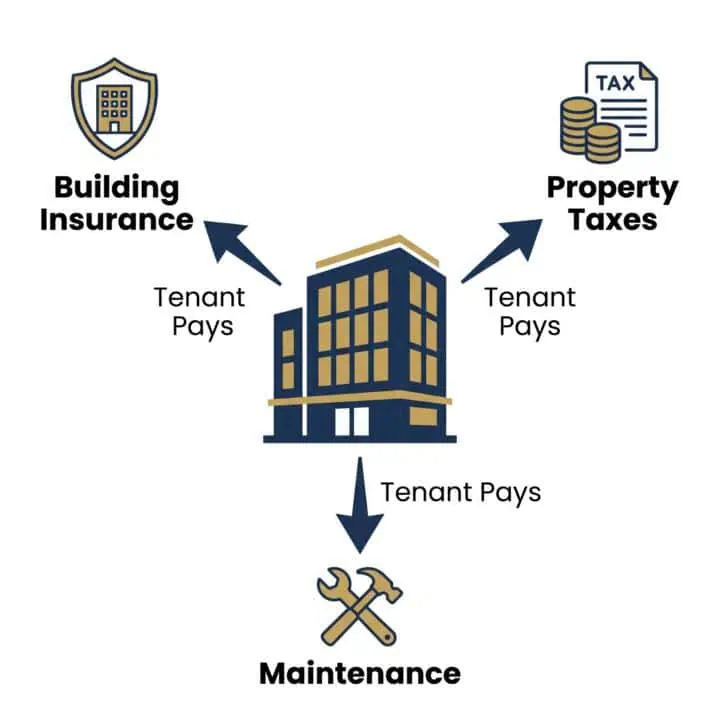
A triple net lease (NNN) is a commercial lease agreement in which the tenant agrees to pay three categories of expenses on top of their base rent:
- Property taxes: The tenant covers all real estate taxes assessed on the property each year.
- Building insurance: The tenant obtains and pays for property insurance against fire, liability, and other losses.
- Maintenance and repairs: The tenant handles routine upkeep, landscaping, parking lot maintenance, and structural repairs, depending on the specific lease terms.
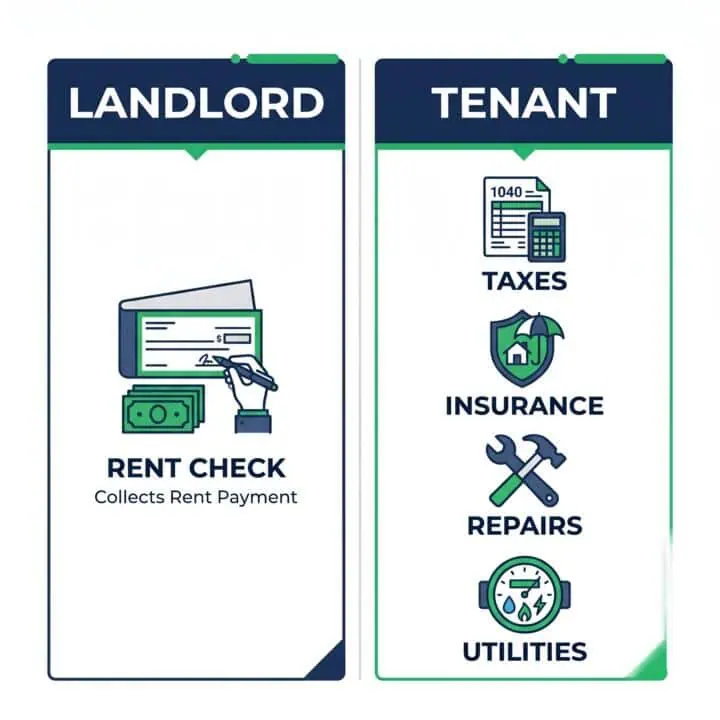
In a standard gross lease, the landlord absorbs all of these costs and builds them into the rent. In an NNN lease, those costs pass directly to the tenant. The landlord collects a lower base rent but has no exposure to operating cost fluctuations. What you see is what you get.
This predictability is what makes NNN leases so attractive to investors, especially those who want reliable income without active property management.
NNN vs. Other Lease Types
Understanding where a triple net lease sits in the spectrum of commercial lease structures helps clarify what you are getting as an investor.
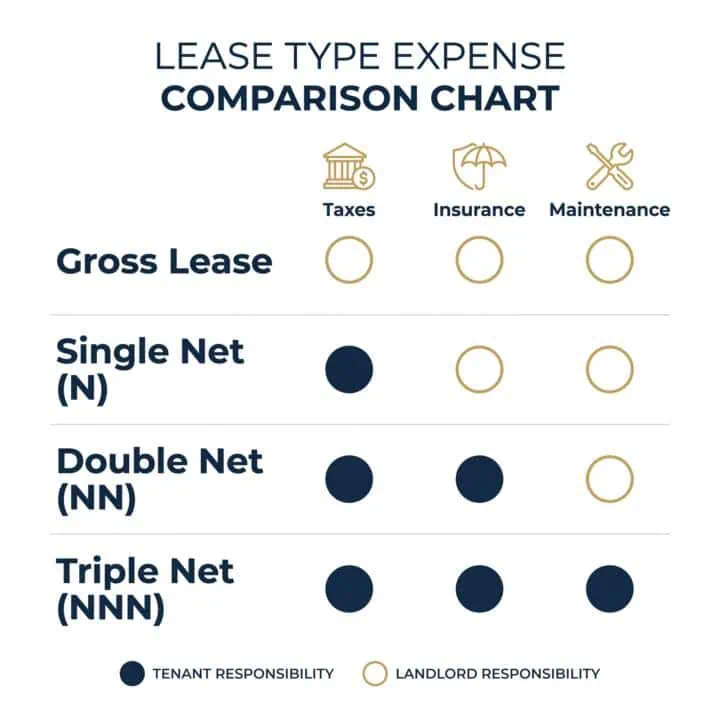
- Gross lease (full-service lease): The landlord pays all operating expenses. The tenant pays one flat rent amount. Common in office buildings.
- Single net lease (N): The tenant pays base rent plus property taxes. The landlord covers insurance and maintenance.
- Double net lease (NN): The tenant pays base rent, property taxes, and building insurance. The landlord still handles maintenance and structural repairs.
- Triple net lease (NNN): The tenant pays base rent plus all three: property taxes, insurance, and maintenance. This is the most landlord-favorable structure in terms of expense exposure.
- Absolute NNN lease: A variation where the tenant is responsible for everything, including roof and structure. Even more favorable to the landlord. Common in sale-leaseback transactions with major retailers.
For investors, the NNN structure is the most common and the most liquid, with the largest pool of buyers if you decide to sell.
What Do Tenants Pay in a Triple Net Lease?
The exact expenses a tenant covers depend on the specific lease language, but in a standard NNN lease the tenant typically pays:
- Base rent (monthly, as stated in the lease)
- Real estate taxes on the property
- Property and casualty insurance premiums
- General maintenance including landscaping, pest control, and exterior cleaning
- Parking lot striping, lighting, and repairs
- HVAC maintenance and replacement
- Plumbing and electrical repairs inside the tenant’s space
- Trash removal and utilities
In an absolute net lease, the tenant also takes on roof repairs, structural wall maintenance, and foundation issues. It is important to read the lease carefully and understand where responsibility ends. Not all NNN leases are identical.
Who Signs Triple Net Leases?
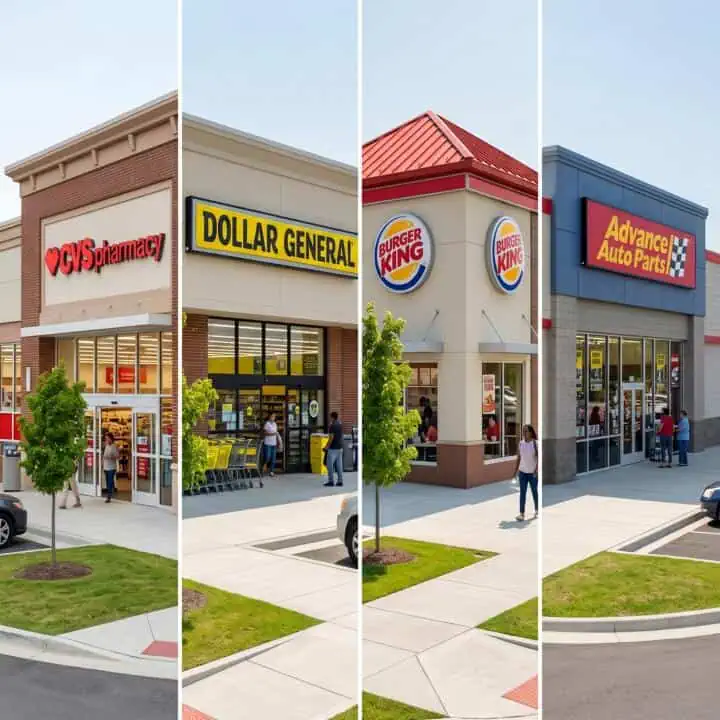
The best NNN investments feature tenants that are large, financially stable, and motivated to maintain a long-term presence in the property. Common NNN tenants include:
- Pharmacies and drug stores: Walgreens, CVS, Rite Aid
- Dollar stores: Dollar General, Dollar Tree, Family Dollar
- Fast food and quick service restaurants: McDonald’s, Burger King, Chick-fil-A, Taco Bell
- Convenience stores and gas stations: 7-Eleven, Casey’s, Wawa
- Big box and discount retailers: AutoZone, O’Reilly Auto Parts, Advance Auto Parts, Tractor Supply
- Grocery-anchored tenants: Aldi, Lidl, Walmart Neighborhood Market
- Medical and dental offices: Often structured as NNN or modified gross leases
- Financial and service tenants: Banks, insurance offices, FedEx, UPS
Investment-grade tenants, meaning those with a credit rating of BBB or higher from Standard and Poor’s, are the gold standard in NNN investing. Their financial strength provides the highest confidence that rent will be paid on time throughout the lease term, including during economic downturns.
Triple Net Lease Terms and Structure
NNN leases are typically long-term commitments. Understanding the structure of a standard deal helps you evaluate any offering.
Initial lease term: Most NNN leases run 10 to 25 years from the date of signing. Fast food and drug store leases commonly start at 15 to 20 years.
Renewal options: Leases usually include multiple renewal options of 5 years each. The tenant, not the landlord, holds the right to exercise each option.
Rent escalations: Most NNN leases include scheduled rent increases built into the lease. Common structures include fixed increases of 5 to 10 percent every 5 years, or annual increases tied to the Consumer Price Index (CPI). These bumps protect your income against inflation.
Corporate guarantee: Many NNN tenants provide a corporate guarantee, meaning the parent company is on the hook for the rent whether or not that specific location is operating. This significantly reduces credit risk if a single store closes.
Lease expiration notice: Most leases require tenants to notify landlords 6 to 12 months in advance if they do not intend to renew. This gives investors time to re-tenant or sell before the cash flow gap begins.

Cap Rates & Returns on NNN Investments
NNN properties are valued based on their capitalization rate, or cap rate. The cap rate is calculated by dividing the annual net operating income (NOI) by the purchase price.
For example, if a Walgreens NNN property generates $150,000 in annual rent and you pay $3,000,000 for it, the cap rate is 5 percent.
Cap rates for NNN investments vary based on:
- Tenant credit quality: Investment-grade tenants command lower cap rates (higher prices) because of their lower risk. A McDonald’s franchise may trade at a 4 to 5 percent cap rate. A less-known regional chain may trade at 6 to 7 percent or higher.
- Lease term remaining: More years left on the lease means less risk of vacancy, which means lower cap rates. A property with 18 years remaining will typically price tighter than one with 4 years remaining.
- Location: Dense urban locations with strong demographics command lower cap rates. Rural or secondary market properties typically trade at higher cap rates.
- Rent escalations: Leases with annual or regular rent bumps are worth more than flat leases because the income grows over time.
As of 2026, NNN cap rates for investment-grade tenants in primary markets generally range from 4.5 to 6.5 percent, though this varies with interest rates and market conditions.
Benefits of Triple Net Lease Investments
NNN properties attract investors for a straightforward reason: you own real estate backed by a creditworthy tenant operating under a long-term contract, and you do almost nothing to maintain it. The benefits below reflect why NNN leases consistently rank among the most sought-after commercial real estate structures for passive investors, retirees, and anyone completing a 1031 exchange who wants to reduce management obligations.
Passive Income with Minimal Management
NNN tenants handle day-to-day property operations. For investors who want predictable income without the headaches of active landlording, there is no more hands-off commercial real estate structure. You collect your check. The tenant manages the property.
Predictable Cash Flow
Because rent is fixed by lease contract, often with scheduled escalations, NNN investors know exactly what they will receive each month for the life of the lease. This predictability is particularly valuable for retirement income planning.
Strong Tenant Covenants
The NNN tenant pool is dominated by well-known, publicly traded companies with long operating histories. These are tenants with corporate backing, high credit ratings, and strong incentives to maintain their locations.
Financing Advantages
Lenders view NNN properties as lower risk than most commercial real estate because of the credit quality of tenants and the long, fixed lease terms. This typically means easier access to financing, lower interest rates, and higher loan-to-value ratios compared to other commercial property types.
Long-Term Income Visibility
A 20-year NNN lease signed today gives you two decades of contracted income. Even if the broader real estate market softens, you have the protection of a long-term contract with a creditworthy tenant.
Estate Planning Simplicity
NNN properties are often used in estate planning because they are easy to transfer, require no active management from heirs, and generate consistent income for beneficiaries.
Risks of Triple Net Lease Investments
NNN properties carry a reputation for safety, and that reputation is largely earned. But the structure that makes them low-maintenance also creates specific vulnerabilities that every investor should understand before buying. The risks below are not reasons to avoid NNN investments. They are the factors to evaluate carefully so you enter any deal with a clear picture of what can go wrong and how to protect against it. No investment is without risk.
Lease Expiration & Re-tenanting Costs
When a major tenant does not renew, the cost of finding a replacement, which may include broker commissions, tenant improvement allowances, and months of vacancy, can be significant. A property purpose-built for one retailer may require expensive renovation to attract a new tenant.
Tenant Credit Deterioration
A tenant that was investment-grade when you bought the property may face financial difficulties over a 15 to 20 year lease term. Retailer bankruptcies do occur, and a tenant in bankruptcy may reject the lease.
Property Obsolescence
A building designed specifically for a drugstore, fast food chain, or big box retailer may have limited alternative uses if the tenant leaves. The more generic the building, the more re-tenanting flexibility you have.
Interest Rate Sensitivity
NNN properties are valued similarly to bonds in that rising interest rates compress prices. If you need to sell in a rising-rate environment, you may receive a lower price than you paid even if the tenant is performing perfectly.
Limited Rent Growth
NNN leases lock in rent for years at a time with modest escalations. In high-inflation environments, your purchasing power can erode even as your nominal income stays flat.
NNN Properties and 1031 Exchanges
NNN properties are one of the most popular replacement property choices in a 1031 exchange. They offer a practical way to transition from active property management into a fully passive investment while deferring capital gains taxes.
The most common scenario: an investor sells an apartment building, retail strip center, or other actively managed property and reinvests the proceeds into an NNN property. The result is the same or larger investment basis but with no management obligations going forward. This is especially attractive for investors nearing retirement.
To use an NNN property in a 1031 exchange, you must identify it as a replacement property within 45 days of selling your relinquished property and close within 180 days. A qualified intermediary holds the proceeds between transactions to preserve the tax deferral. Learn more about the full process on our 1031 exchange page.
For investors who want to defer taxes but prefer fractional or pooled NNN ownership rather than a single property, DST 1031 exchange structures often include NNN leased properties and can be used as qualifying replacement property.
Browse our current NNN investment properties to see what is available.
How to Find and Evaluate NNN Properties
NNN properties are sold through commercial real estate brokers, national listing platforms, and through advisors who specialize in 1031 exchange replacement properties.
When evaluating any NNN opportunity, focus on these factors:
- Tenant credit: Is the tenant publicly traded? What is their credit rating? Have they had store closures in similar markets? Look beyond the brand name and into the financial statements.
- Years remaining on the lease: Properties with fewer than 5 years remaining on the initial lease term carry significant re-tenanting risk. Properties with 10 or more years of term remaining are generally preferred.
- Rent escalation schedule: Flat leases lose purchasing power over time. Prefer leases with regular rent bumps built in.
- Location fundamentals: A great tenant in a poor location is still a risk. Look at traffic counts, population density, demographic trends, and the performance of other retailers nearby. The tenant chose that location for a reason, but is that reason still valid?
- Building condition and age: Understand what capital expenditures may be coming and who is responsible for them under the lease.
- Cap rate vs. market: Compare the asking cap rate to recent comparable sales. If the cap rate looks too high for the tenant quality and remaining term, there may be a reason the seller is eager to exit.
Our NNN properties for sale page lists current available offerings, and our advisors can help you evaluate any listing relative to your goals and timeline.
Frequently Asked Questions
What is a triple net lease (NNN)?
A triple net lease is a commercial lease in which the tenant pays base rent plus three operating expenses: property taxes, building insurance, and maintenance costs. The landlord collects rent without bearing day-to-day operating costs. It is the most common lease structure for single-tenant retail properties and is widely used by pharmacies, fast food chains, dollar stores, and convenience stores.
What does NNN mean in real estate?
NNN stands for triple net. Each “N” represents one of the three expenses the tenant is responsible for: (1) property taxes, (2) building insurance, and (3) maintenance. The abbreviation is used interchangeably with “triple net lease.”
What is the difference between a gross lease and a triple net lease?
In a gross lease, the landlord pays all operating costs and charges the tenant a single all-inclusive rent. In a triple net lease, those costs transfer to the tenant. The landlord receives a lower base rent but has no exposure to rising taxes, insurance premiums, or maintenance costs. NNN investors generally prefer the predictability of the net lease structure.
What is the difference between NNN and NN (double net)?
In a double net lease, the tenant pays base rent, property taxes, and insurance, but the landlord remains responsible for maintenance and structural repairs. In a triple net lease, the tenant takes on maintenance as well. A triple net lease shifts more expense risk to the tenant and is therefore more favorable to the investor.
What kind of returns can I expect from NNN investments?
NNN cap rates for investment-grade tenants currently range from roughly 4.5 to 6.5 percent depending on the tenant, lease term, and location. Cap rates are not the same as total return; if you use leverage and property values appreciate, total returns can be higher. If you buy at a 5 percent cap rate and rates rise, the value of the property may decline even if the tenant continues paying rent.
Are NNN leases a good investment?
NNN leases are a strong choice for investors seeking passive income, predictable cash flow, and creditworthy tenants. They are particularly well-suited for investors who want to reduce management obligations, are approaching retirement, or need a reliable income stream. They carry real risks, including lease expiration, tenant bankruptcy, and interest rate sensitivity, so due diligence on the tenant and lease terms is essential.
Can I use an NNN property in a 1031 exchange?
Yes. NNN properties are one of the most common replacement property choices in a 1031 exchange. They qualify as like-kind real estate, and investors frequently use them to exchange out of actively managed properties into passive income. You must identify your replacement property within 45 days of selling your relinquished property and close within 180 days.
What happens when an NNN lease expires?
When the lease expires, the tenant has the option to renew (usually for 5-year extension periods) or vacate. If the tenant does not renew, the landlord must find a new tenant. Re-tenanting can be costly, especially for purpose-built single-tenant properties. Most leases require tenants to give 6 to 12 months notice if they do not intend to renew, which gives investors time to plan.
What is a corporate guarantee in an NNN lease?
A corporate guarantee means the parent company (not just the individual franchisee or location) is obligated to pay the rent. If a single location closes but the lease has a corporate guarantee, the company is still on the hook for rent payments. Corporate guarantees significantly reduce risk for investors compared to franchisee-only guarantees.
How is an NNN property valued?
NNN properties are valued based on their cap rate, which is annual net operating income divided by purchase price. Lower cap rates reflect lower risk (strong tenants, long leases, prime locations) and higher prices. Higher cap rates reflect higher risk and lower prices. Changes in market interest rates also affect NNN property values, similar to how bond prices move inversely to interest rates.